How to Choose a 277-Volt LED Retrofit Can Light
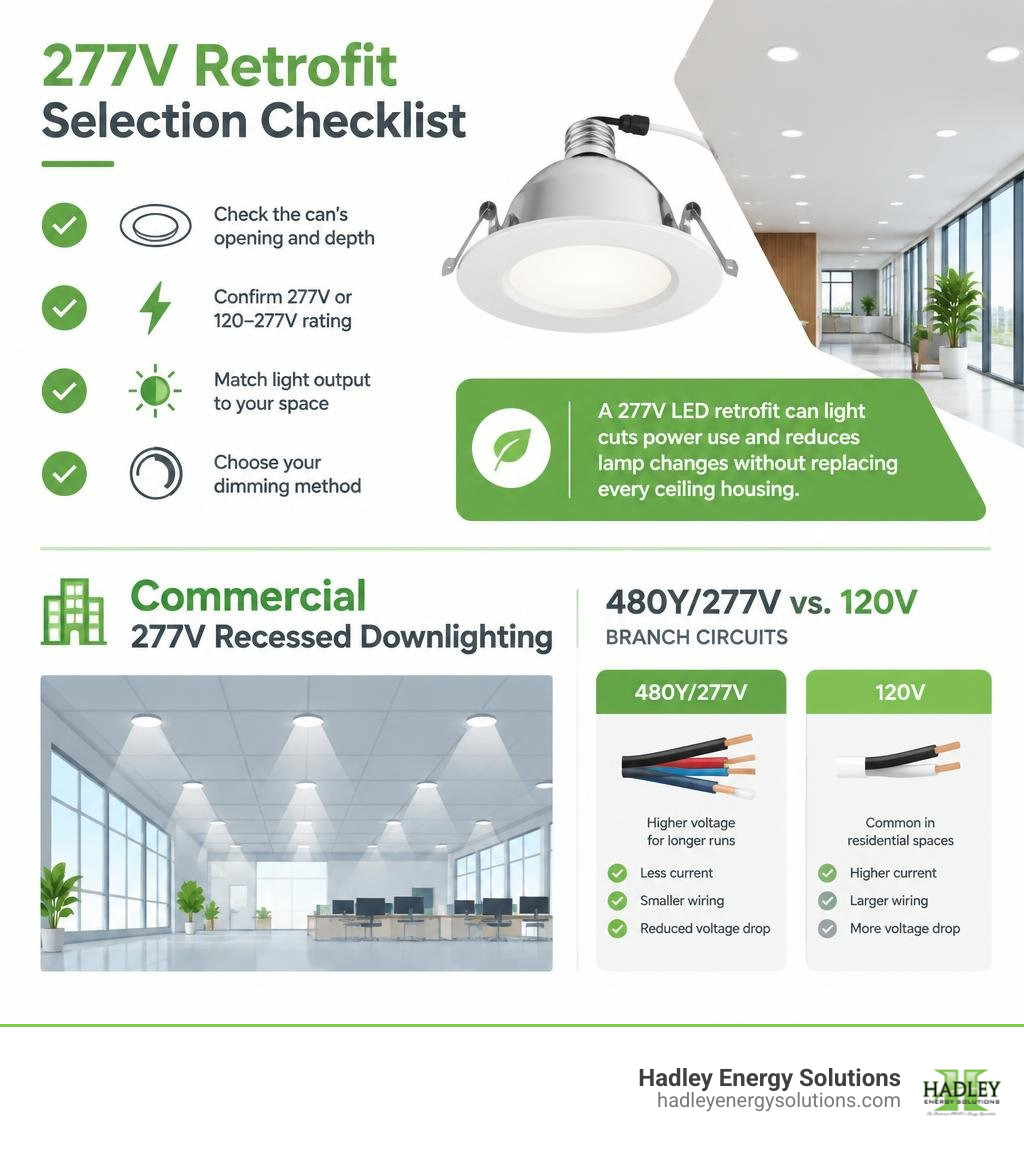
A 277 volt LED retrofit can light can replace an older downlight while keeping its existing recessed housing, if the retrofit is listed for that housing. To find the right one, check the can’s opening and depth, confirm the fixture is rated for 277V or 120–277V, and match its light output and dimming method to your space and controls. A compatible LED retrofit can cut power use and reduce lamp changes without replacing every ceiling housing.
I’m Rodney Hadley, a licensed Master Electrician and Certified Energy Auditor with more than 13 years of experience in lighting design and efficiency retrofits. I’ll walk you through what matters when choosing a 277 volt LED retrofit can light for a commercial building.
Understanding Commercial 277V Recessed Downlighting
Commercial electrical systems are built to handle massive energy loads across sprawling square footage. In large facilities, operating lights on traditional residential voltage leads to thick wiring, crowded conduit runs, and significant voltage drop over long distances. That is why commercial infrastructure relies on higher-voltage power distribution.
When managing overhead costs across office parks, hospitals, retail centers, and educational campuses, upgrading your recessed lighting begins with understanding your building's native power supply.
What Is a 277 Volt LED Retrofit Can Light and How Does It Work?
A 277V LED retrofit downlight is an engineered luminaire assembly designed to install directly into an existing recessed housing ("can") and operate on 277 volts of alternating current (VAC). In North American commercial buildings, heavy power loads—such as large HVAC chillers, air handlers, and pumps—are supplied by a 480Y/277V three-phase, four-wire electrical service.
While 480V runs line-to-line to power heavy industrial equipment, the line-to-neutral voltage across any single phase yields exactly 277V. Commercial facility designers tap this 277V branch power directly for overhead lighting circuits.

Modern retrofit luminaires feature universal internal drivers that operate across a wide input range of 120V to 277V (and occasionally up to 347V). Instead of relying on a failure-prone legacy magnetic or electronic ballast, an LED retrofit kit connects directly to line voltage. The integrated driver rectifies the 277V AC input into clean, low-voltage direct current (DC) that powers the internal LED array.
By following a comprehensive lighting retrofit guide, facility managers can convert aging fluorescent, incandescent, or high-intensity discharge (HID) recessed cans into efficient solid-state lighting without tearing open drywall or disturbing ceiling grid infrastructure.
Commercial 277V vs. Residential 120V Downlights
The fundamental physical difference between commercial 277V and residential 120V recessed lighting comes down to basic electrical formulas: watts equal volts multiplied by amps.
Because the voltage in a 277V circuit is more than double that of a standard 120V circuit, the amperage required to produce the exact same wattage is reduced by roughly 57 percent.
Lower amperage provides substantial engineering advantages in commercial environments:
- Smaller Wire Gauges: A branch circuit carrying lower current can use thinner copper wire (such as 12 AWG or 14 AWG) over long runs without causing excessive heat buildup or dangerous line voltage drop.
- Higher Fixture Capacity Per Circuit: A standard 20-amp commercial breaker operating at 277V can safely support up to 4,432 watts of continuous lighting load (based on the standard 80% NEC continuous load rule). In contrast, a 120V 20-amp circuit can only support 1,920 watts.
- Streamlined Electrical Panels: Fewer branch circuits mean smaller distribution panels, fewer breakers, and simplified maintenance for on-site facility engineers.
| Electrical Parameter | 120V Residential Downlights | 277V Commercial Downlights |
|---|---|---|
| Typical Line Voltage | 120 VAC (Single-Phase) | 277 VAC (Line-to-Neutral of 480V 3-Phase) |
| Current for 1,000W Load | 8.33 Amps | 3.61 Amps |
| Max Safe Continuous Load (20A) | 1,920 Watts | 4,432 Watts |
| Max 15W LED Fixtures per 20A Circuit | ~128 Downlights | ~295 Downlights |
| Primary Dimming Protocol | TRIAC / Forward/Reverse Phase | 0-10V Low-Voltage DC |
| Common Cable Types | Non-Metallic (NM / Romex) | Metal-Clad (MC / BX) or Conduit |
Selecting the Best 277 Volt LED Retrofit Can Light for Commercial Facilities
Navigating commercial retrofit catalogs requires matching physical dimensions, light quality, and electrical controls to your facility's operational needs.
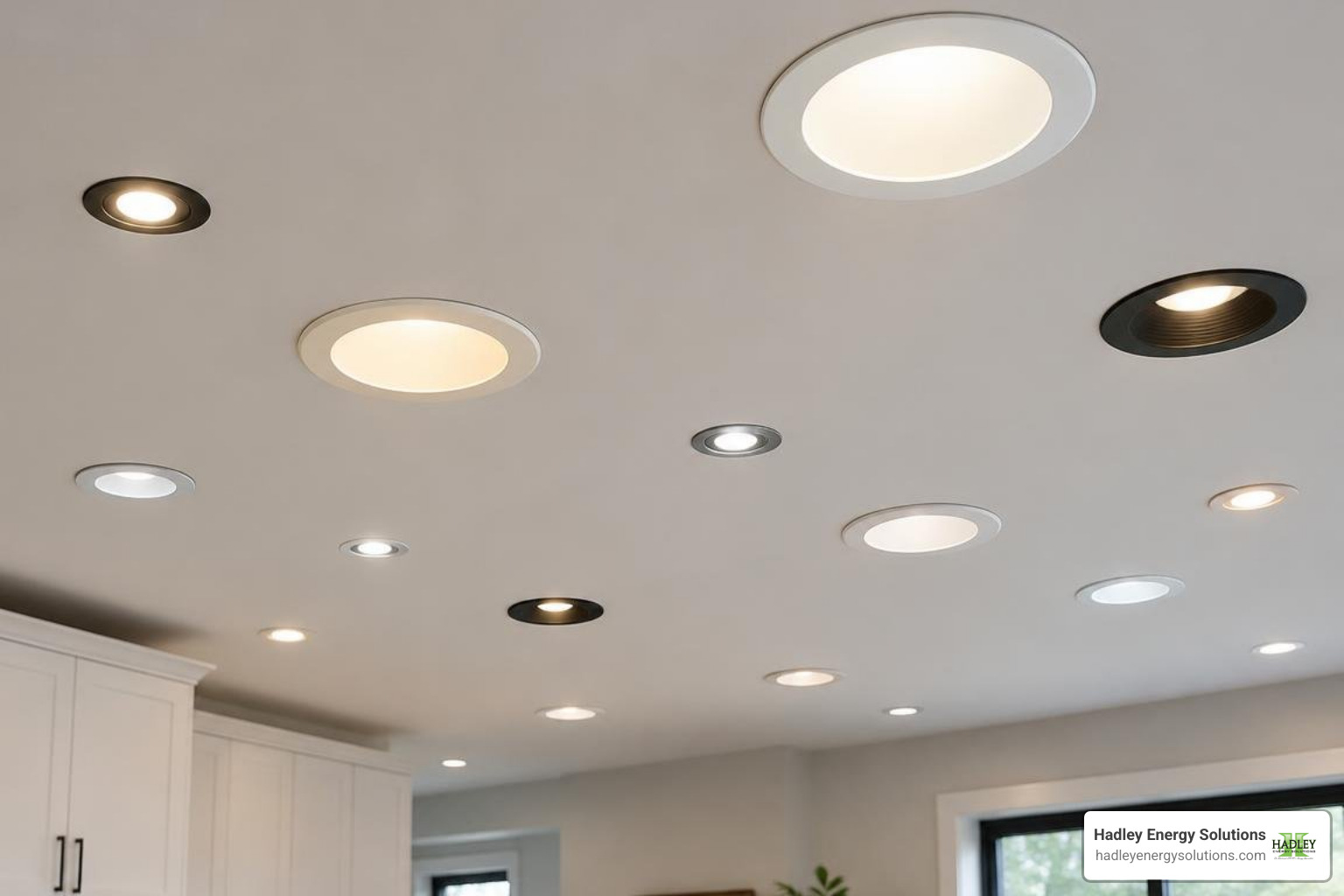
Sizing and Optical Performance
Commercial can lights generally range from 4-inch to 10-inch aperture diameters:
- 4-Inch Fixtures: Ideal for architectural accenting, task illumination, and low-plenum corridors, drawing between 8W and 12W while delivering 650 to 900 lumens.
- 6-Inch Fixtures: The workhorse of commercial offices, healthcare facilities, and classrooms. Modern units draw 10W to 23W to replace 65W to 150W legacy lamps, generating between 900 and 2,300 lumens.
- 8-Inch and 10-Inch Fixtures: Designed for high-ceiling retail floors, hotel atriums, and convention spaces, drawing 25W to 40W to deliver 2,500 to 3,500+ lumens.
Leading manufacturers provide field-selectable wattage switches (such as toggling between 11W, 16W, and 23W) and 5CCT color selection (2700K, 3000K, 3500K, 4000K, and 5000K) mounted on the remote driver or junction box. Specifying high color quality—specifically a Color Rendering Index (CRI) of 90 or higher—is critical in retail, healthcare, and corporate settings where true color perception matters.
For detailed dimensional tolerances and mechanical mounting options, consult the commercial downlight retrofit engineering specifications.
Commercial Dimming Protocols and Emergency Battery Backup
Residential recessed lighting relies heavily on line-voltage phase-cut (TRIAC or ELV) dimming, which slices the AC sine wave to reduce light output. On 277V commercial circuits, phase-cut dimming is uncommon and often unstable.
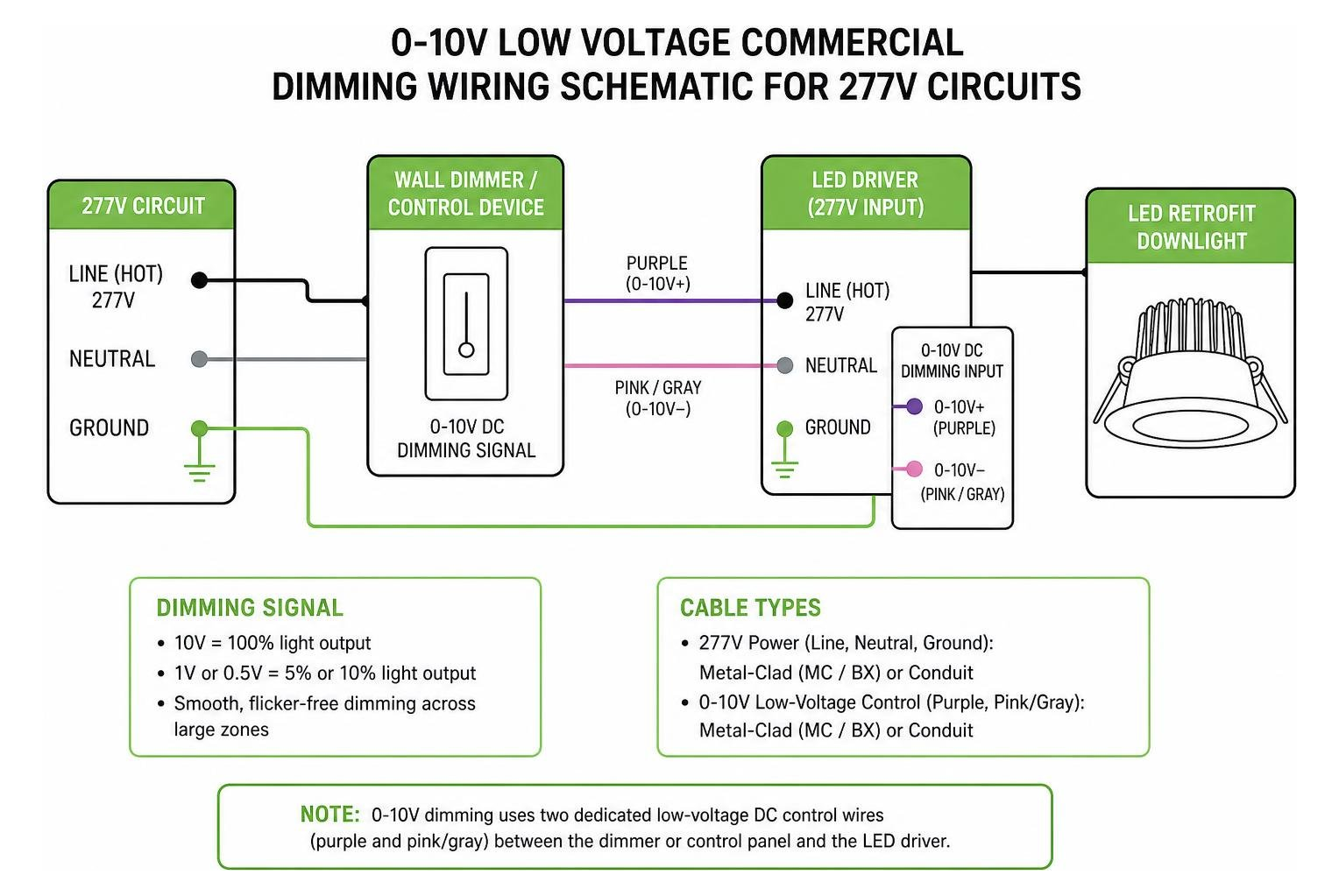
Instead, commercial 277V retrofits use 0-10V direct current (DC) low-voltage dimming. In this system, two dedicated control wires (typically purple and pink/gray) run between the LED driver and a wall dimmer or lighting automation panel. The driver reads a signal ranging from 10V (100% full output) down to 1V or 0.5V (dimmed down to 5% or 10% output), providing smooth, flicker-free dimming across large zones. Pairing modern fixtures with integrated lighting controls allows facilities to implement daylight harvesting and occupancy scheduling that slashes utility bills even further.
Commercial building codes (such as NFPA 101 Life Safety Code) also mandate that designated egress pathways maintain emergency illumination for a minimum of 90 minutes during a power failure. Top-tier 277V LED retrofit downlights offer field-installable or factory-integrated emergency battery backup units (typically 9W to 18W outputs). These modules detect utility power loss and instantly supply battery power to run the downlight at code-compliant emergency lumen levels.
Essential Safety Ratings and Building Energy Certifications
When upgrading commercial facilities, your fixtures must comply with regional building codes and safety standards:
- Type IC (Insulation Contact): Fixtures rated Type IC are certified for direct contact with ceiling insulation, preventing fire hazards in insulated plenums. Non-IC fixtures require a minimum 3-inch clearance from all combustible materials.
- Wet and Damp Location Listings: Damp-location fixtures suit interior hallways, offices, and conference rooms. Wet-location ratings are required for commercial bathrooms, shower rooms, outdoor covered soffits, and building entryways.
- Airtight Construction (ASTM-E283): Certified airtight housings restrict conditioned air from escaping into unconditioned ceiling plenums, reducing building HVAC loads.
- Energy Code Compliance: High-efficacy models certified under ENERGY STAR and California Title 24 Joint Appendix 8 (JA8) ensure compliance with strict state and municipal energy conservation ordinances. Review the specification data on high-efficiency downlight modules to verify rebate eligibility.
Financial and Operational Payback of 277V LED Retrofits
Upgrading legacy commercial can lights to 277V LED retrofits provides an immediate return on investment (ROI) across energy, labor, and thermal overhead.
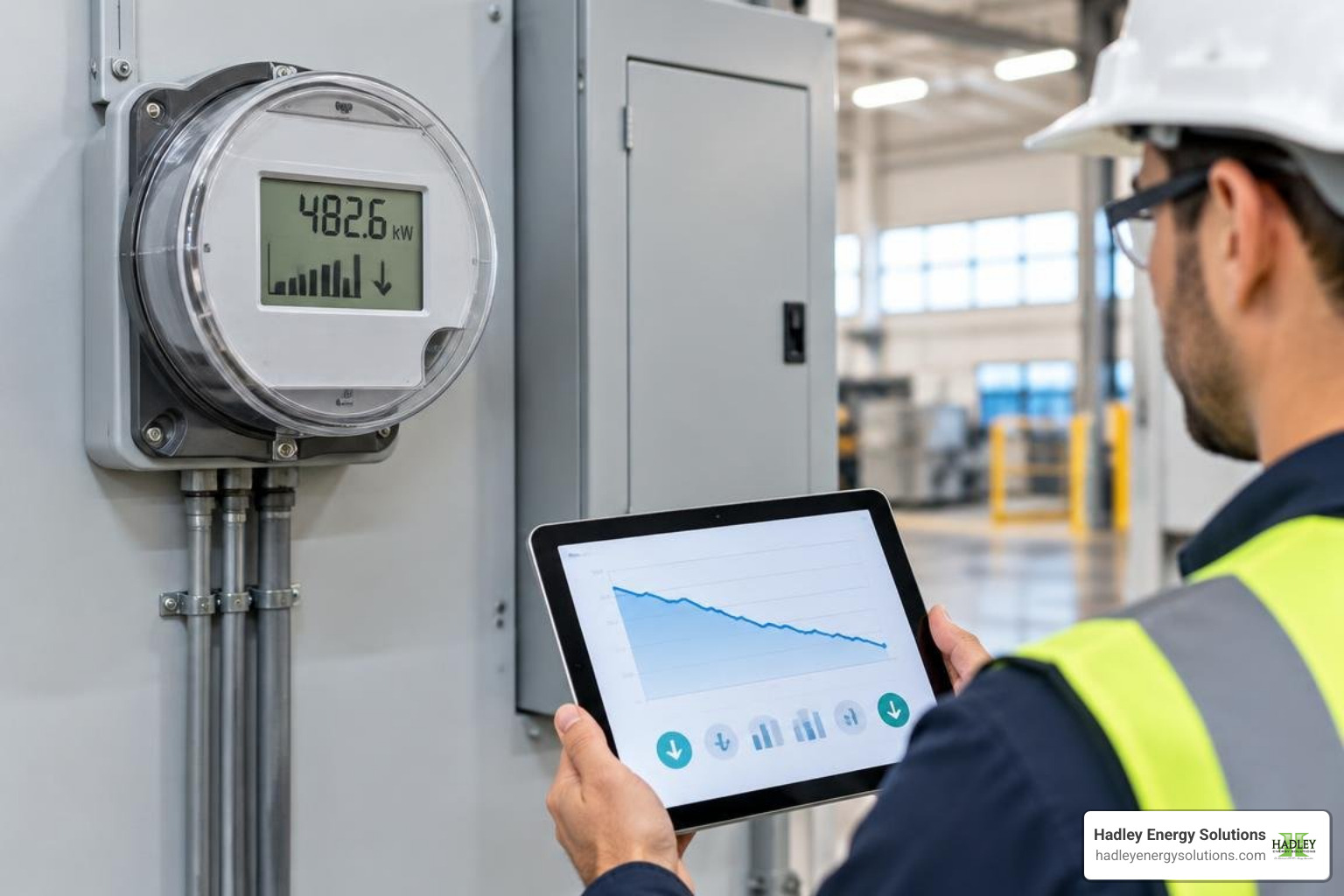
Energy Reductions Exceeding 80%
Legacy commercial downlights commonly house twin 26W compact fluorescent lamps (CFLs) or 100W to 150W incandescent and HID bulbs. Factoring in ballast power losses, an older dual-CFL downlight often draws 58 to 64 watts of continuous power.
A modern 6-inch commercial 277V LED retrofit delivers equivalent or superior light output using just 10W to 12W, generating an immediate 80% to 84% reduction in electrical demand.
Drastic Maintenance and Relamping Savings
Maintaining legacy can lights in commercial facilities is costly. Tucking replacement lamps and ballasts into high-ceiling lobbies, stairwells, and multi-tenant corridors requires rolling out scaffolding or setting up lifts, taking maintenance staff away from other priorities.
- Legacy Lamp Lifespan: Incandescent lamps last 1,000 hours; commercial CFLs last roughly 10,000 hours.
- LED Retrofit Lifespan: Commercial-grade LED engines carry L70 ratings of 50,000 to 70,000 hours—delivering over 15 to 20 years of maintenance-free operation under typical business hours.
HVAC Heat Load Mitigation
Incandescent and HID lamps convert over 80 percent of their input energy into radiant heat rather than visible light, and magnetic ballasts radiate continuous thermal energy directly into the ceiling plenum.
Solid-state LED downlights run cool, utilizing die-cast aluminum heat sinks to manage thermal dissipation. Every watt of lighting energy reduced takes pressure off your air conditioning system, further lowering summer peak demand charges. Integrating these upgrades through holistic commercial lighting design strategies ensures light levels, spacing, and energy profiles are balanced for long-term savings.
Installation and Electrical Safety Guidelines
Working with 277V commercial circuits carries significantly higher safety risks than working with residential 120V systems. An electrical arc or contact event at 277V carries higher potential energy, making strict adherence to National Electrical Code (NEC) and OSHA protocols mandatory.
Step-by-Step Installation of a 277-Volt LED Retrofit Can Light
A Type B (ballast bypass) retrofit connects line-voltage wiring directly to the LED downlight driver. Follow these professional steps to complete a safe installation:
- Implement Lock-Out / Tag-Out (LOTO): De-energize the dedicated 277V lighting branch circuit at the distribution panel. Lock the breaker handle and tag it with appropriate warning labels. Always verify the absence of voltage inside the fixture housing using a calibrated digital multimeter or non-contact voltage tester.
- Remove Old Trim and Lamps: Extract the existing reflector cone, trim ring, and legacy lamps from the can housing.
- Bypass and Disconnect the Existing Ballast: Open the fixture's junction box access plate inside or above the ceiling. Cut the input power leads (277V hot and neutral) feeding the ballast, and cut the secondary output leads running to the lamp socket. Disconnect or remove the ballast from the housing entirely to eliminate dead weight and phantom resistance.
- Connect Input Wiring and Dimming Controls: Bring the 277V line voltage conductors directly into the retrofit fixture’s all-in-one junction box. Secure metallic armored (BX/MC) cable or conduit fittings. Splice the line (black), neutral (white), and ground (green/bare) using listed lever nuts or wire connectors. If utilizing 0-10V dimming, connect the low-voltage control lines (purple to positive, pink/gray to negative).
- Attach Safety Tether: Fasten the retrofit unit’s aircraft safety cable to the structural can housing or framing bracket to prevent accidental drops during ceiling tile adjustments.
- Insert Retrofit Module and Secure Trim: Compress the heavy-duty torsion springs or friction retention clips on either side of the trim. Push the retrofit downlight upward into the housing until the trim ring sits flush against the ceiling surface.
- Re-Energize and Commission: Remove locks, restore circuit power, and test both full-range illumination and 0-10V dimming response.
For multi-circuit facilities or complex panel layouts, contracting certified commercial electrical services ensures work is completed safely and in compliance with local commercial building codes.
Frequently Asked Questions About 277V LED Can Lights
Can 277-volt LED retrofit can lights be dimmed on commercial circuits?
Yes. Commercial 277V LED retrofits are designed to pair with industry-standard 0-10V low-voltage DC dimmers. This separate control circuit provides smooth, flicker-free dimming from 100% down to 5% or 10% output without introducing harmonic distortion or buzzing on your electrical branch lines.
Do 277V LED downlight retrofits require removing the existing ballast?
Yes. Standard commercial 277V LED downlight retrofits operate as Type B direct-wire fixtures. The legacy fluorescent or HID ballast must be bypassed and disconnected. Wiring line voltage (120–277V) directly to the LED driver eliminates the ballast as a future point of failure and cuts continuous ballast standby power losses.
How do I choose the correct can size for a 277V retrofit fixture?
Measure the inside diameter of your existing recessed metal housing across the bottom opening:
- An opening between 4.0 and 4.5 inches requires a 4-inch retrofit.
- An opening between 5.75 and 6.5 inches fits a standard 6-inch retrofit.
- Openings of 7.5 to 8.5 inches or larger require 8-inch or 10-inch commercial retrofit kits.
Universal commercial retrofit units feature adjustable tension mounting clips that accommodate minor variations in housing depth and aperture diameter, ensuring a tight seal against the ceiling.
Conclusion
Upgrading outdated, power-hungry recessed downlights to high-efficiency 277 volt LED retrofit can lights is one of the fastest, most cost-effective ways to cut commercial operating expenses. By utilizing existing ceiling cans, bypassing old ballasts, and stepping up to selectable-wattage, 0-10V dimmable LED technology, commercial property owners routinely eliminate over 80 percent of their downlight energy load while saying goodbye to ongoing relamping maintenance.
At Hadley Energy Solutions, based in Louisville, Kentucky, we combine integrated, dual-licensed electrical and mechanical expertise under one roof. We help facility executives, property managers, and commercial building owners design and install turnkey upgrades backed by 24/7 emergency response, a written workmanship warranty, and guaranteed energy savings.
Contact our team today to evaluate your facility's infrastructure and schedule turnkey commercial lighting retrofits tailored to your operational goals.
Hadley Energy Solutions Team
With 100+ years of combined experience, our team of licensed electricians, HVAC technicians, and certified energy auditors serves Louisville, KY and Southern Indiana. Licensed CE64623 | ME64500 | HM06538.